Applications
Purpose-built silicon
for real-world electronics.
Not every integrated circuit needs billions of transistors.
Many products require sensing, interfacing, timing, control and application-specific logic.
Those functions can benefit more from customization, integration and development speed than from leading-edge transistor density.
xSilica is built for that part of the semiconductor landscape.
Industrial Control
Put the interface and control logic where it belongs.
Industrial systems contain large amounts of electronics whose job is not high-performance computation.
They sense, condition and compare signals; sequence and control systems; and communicate with the surrounding product.
Many of these functions can be integrated into application-specific silicon.
Why customize?
Custom silicon can reduce component count, simplify PCB architecture, lower power consumption and place proprietary behavior inside a device that is harder to copy than firmware or a board design.
Why rapid iteration?
Industrial products often evolve around real-world system behavior that cannot be fully predicted in simulation. Conventional ASIC development encourages teams to wait until the architecture is stable. Rapid silicon makes it possible to validate integration earlier while the product is still learning.

Suitable functions
Aerospace & Defense
Specialized silicon for systems that cannot always depend on commodity roadmaps.
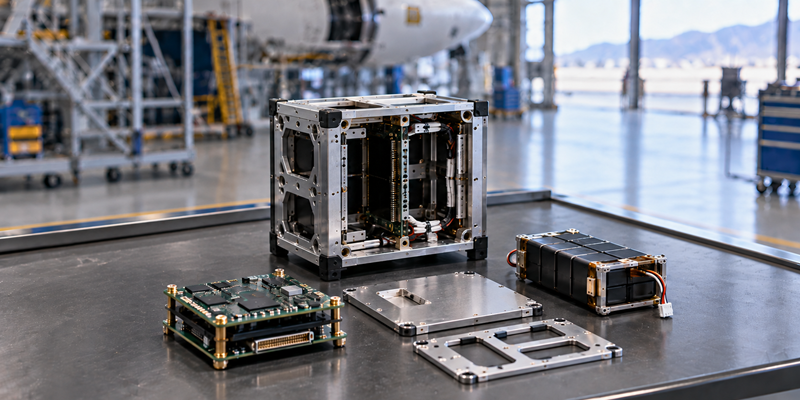
Aerospace and defense systems frequently operate at volumes where conventional ASIC economics are difficult to justify.
At the same time, development speed, supply-chain visibility, long product lifetimes and local manufacturing capability can carry unusually high value.
Speed can matter more than die price.
In some programmes, a month of waiting costs considerably more than an individual prototype wafer. Rapid iteration therefore changes the economic trade-off.
European manufacturing
xSilica is being developed in Eindhoven as a European-controlled semiconductor capability. This creates a potential route for projects where local engineering access, supply-chain sovereignty and IP handling matter.
Rapid CMOS should not be interpreted as automatically qualified for aerospace or defense environments. Radiation tolerance, reliability qualification and application-specific certification remain separate engineering requirements.
Suitable functions
Automotive Development
Custom silicon before production silicon.
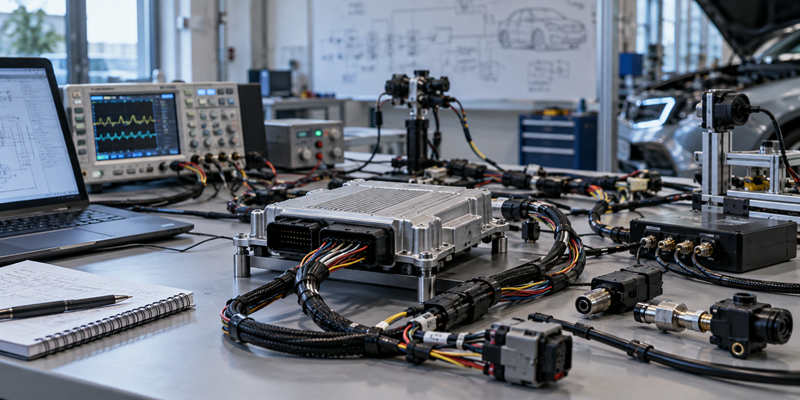
Automotive electronics eventually require exceptional levels of process control, qualification, traceability and manufacturing discipline. That is not the initial role of Rapid CMOS.
Its near-term opportunity is earlier in the development programme.
This allows teams to learn from physical integrated silicon before committing to the process, tooling and qualification route required for series production.
Where a design progresses towards a production vehicle, migration to an appropriately qualified semiconductor process remains a separate step.
Rapid CMOS targets the learning phase. It does not imply automotive production qualification.
Custom silicon can be useful during:
Medical & Scientific
Purpose-built electronics for the systems that measure, monitor and investigate.
Medical devices, laboratory equipment and scientific instruments often depend on specialized electronics around their sensors, actuators and measurement systems.
These products can benefit from integrating signal conditioning, timing, control and application-specific interface functions into a device designed around the instrument rather than assembled from a broad collection of general-purpose components.
Why customize?
Selected mixed-signal and control functions can reduce component count, simplify the signal path and make an instrument's electronics more specific to its sensing method, workflow and operating environment.
Why rapid iteration?
Measurement systems are often refined through experiments with real samples, sensors and fixtures. Rapid silicon makes it possible to test integration choices while the instrument architecture is still learning, before a production implementation is fixed.
Rapid CMOS is a development platform, not a medical-device qualification claim. Clinical use, safety, reliability, packaging, biocompatibility and application-specific regulatory requirements remain separate engineering and validation work.

Suitable functions
Data Center Infrastructure
Not every data-center chip is a processor.
Servers and data-center systems contain large amounts of infrastructure electronics around the CPUs, GPUs and accelerators doing the primary computation.
These functions are often distributed across management controllers, monitoring devices, interface components and discrete support circuits, and are excellent candidates for mature CMOS.
Why customize infrastructure electronics?
Selected monitoring, sequencing, control and interface functions can be integrated into one application-specific device. That can simplify board architecture, reduce component count and bring product-specific behavior closer to the hardware it supports.
Rapid iterations make it possible to validate those integration decisions against real power, thermal and operational behavior while the system architecture is still evolving.
Rapid CMOS does not compete with advanced-node processors. It targets the monitoring, management and control electronics surrounding them.

Suitable functions
Home & IoT
Fewer parts. More product-specific electronics.
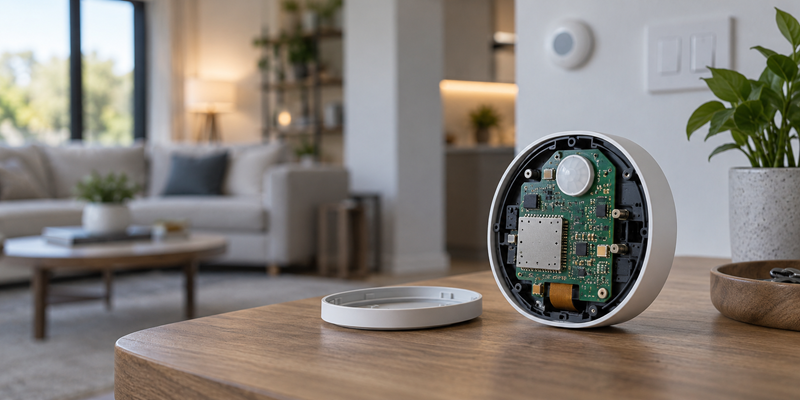
Connected products and appliances often combine microcontrollers, sensors, interface devices, analog components and application-specific logic.
Custom silicon can integrate functions that would otherwise occupy several devices.
Why integrate?
Combining selected sensing, timing, control and interface functions can reduce component count, simplify PCB architecture and make the electronics more specific to the product it serves.
For many product companies, this is exactly the class of electronics that historically stops at PCB level. The company may have capable electrical engineers. The product may genuinely benefit from integration.
But the volume, development budget or requirements maturity does not justify launching a conventional ASIC programme.
xSilica aims to move that boundary by making custom silicon practical to explore while the product is still learning.
Suitable functions
Start a conversation
What could your product learn from custom silicon?
Rapid CMOS is intended for the practical electronics between sensors and software—where integration, learning speed and product-specific behavior can matter more than transistor density.